
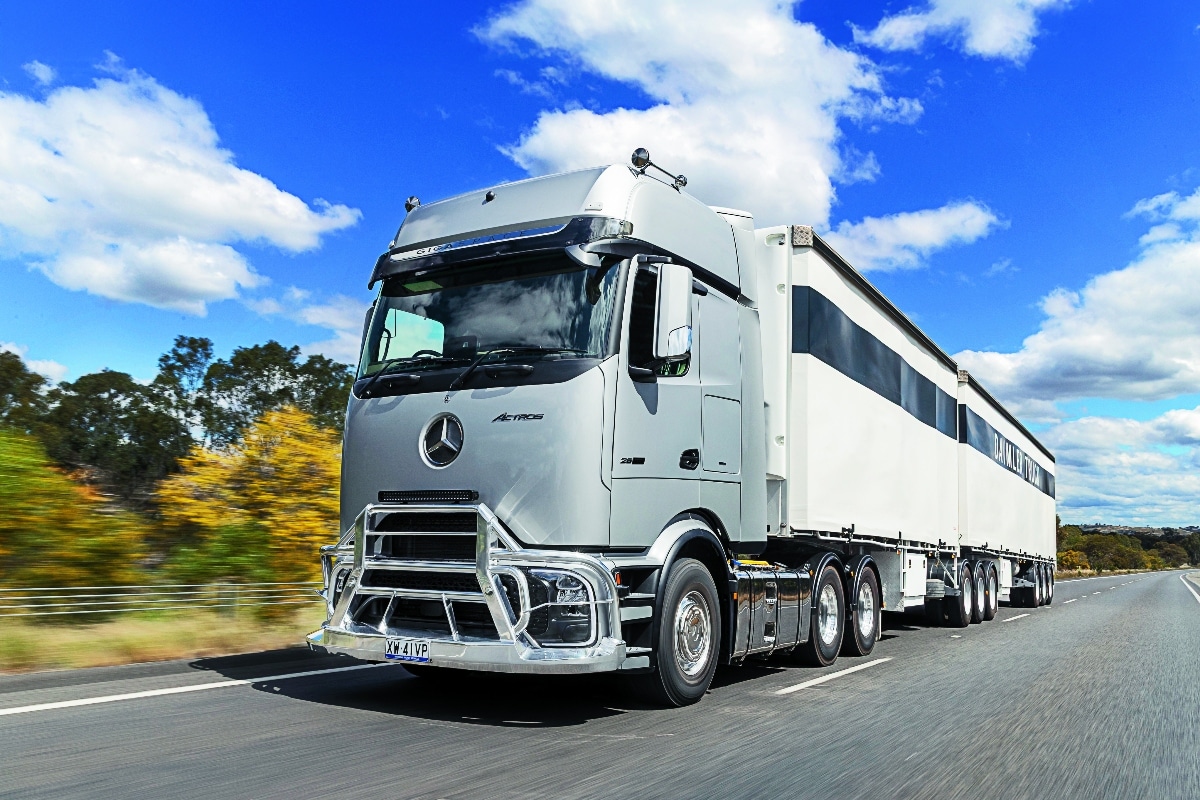
I am putting that out there because it definitely has that electric look and some have made that comment, and I will put my hand up here and admit, when I first saw the Mercedes ‘ProCabin’ at the Brisbane Truck Show in March, I looked from a distance and murmured to myself ‘actually that doesn’t look too bad for an electric vehicle’.
But that truck on display wasn’t an electric vehicle, and this one, that I had the privilege of test driving recently also wasn’t an electric vehicle. What it is, is the unveiling of Mercedes new ProCabin.
Before we get into a rundown of my Albury to Laverton morning escapades in the new ProCabin, let’s just fill in the gaps as to the what and why of this all-new design.
The ProCabin is a predominately exterior redesign of Mercedes 2.5m cabs. The roots of change lay with the European Union and their constantly changing Weights and Dimensions Directives. Sound complicated? Well, I’m not going to break them all down. Suffice to say, amendments have recently been made that allow European manufacturers an additional 80-90 mm out the front – for vehicles that feature improved aerodynamics, vision and safety.
What those amendments meant for Mercedes was that they could redesign their whole 2.5m cab range with an even stronger emphasis on aerodynamics.
The goal with any cabover vehicle has always been to more air over the truck, around the truck and under the truck as smoothly as possible. Making them as aerodynamically efficient as a big brick can be. With the new Euro regulations some white coat wearing brainiacs at Mercedes headquarters have been able to do exactly that with the new ProCabin.
The most obvious example of change is the massive front grill. Or technically the front façade would be more accurate as there doesn’t appear to be anything we’d identify as a front grill now. The front panel now extends basically down to the bottom third of the truck.
Along with this, the Mercedes whizzes have also sealed the cab to the chassis. I don’t mean you can flip the cap, but when you do the front guards and wheel arches will remain fixed. Yes, I questioned how the mechanics will feel about that as well. Seems we can’t keep everyone happy. The plus side of this redesign is that it prevents air from getting in and around underneath the cab and creating aerodynamically draining turbulence. Which in the real world leads to increased fuel savings. Add in a redesign on the aero kit and an additional spoiler to assist the roof kit, along with the spoiler underneath the cab and there is talk of around a 3 per cent fuel efficiency savings. Just from the aerodynamics.
Seeing as I am not an aerodynamic engineer, but I do drive trucks, and I spend a lot of time driving in and around Queensland, my queries tended to be around ‘Doesn’t all that smooth, aerodynamic, flat facing façade effect the cooling?’ Colour me surprised but no, it doesn’t. This is where the EU’s generous gift of an 80mm growth spurt to cabovers has paid dividends.
It isn’t quite as glaring as the front façade, but it is because of that added 80mm that the design engineers have been able to round out and cover up the majority of the front end. It’s all wind tunnel numbers and airflow results but the dumbed down version is angling the front allows and encourages uninterrupted airflow. Not only has it allowed the engineers to redirect air more efficiently, but it has also allowed them to make better use of the air flow around the radiator. Compared to the previous Actros iteration the direct airflow to the radiator has significantly improved with the new ProCabin models.
Mercedes have been testing and evaluating the new design under Australian conditions since the first ProCabin arrived in March. Whilst that may not seem enough to establish itself in the testing Aussie conditions it is worth noting that the ProCabin has been put through very thorough testing throughout South Africa and the middle east, with loads very much on par with what the Mercedes is marketed for here in our hot desolate driving arena.
Aerodynamics are pretty much the whole selling point of the new ProCabin. The cab layout, including the excess of interior luxury and all the bells and whistles you expect of a modern-day Mercedes are still at the 5-star level the manufacturer is renowned for. However, the other upgrade you will get with the introduction of the new cab range is a move to Mercedes Next Generation of safety and emergency braking – Gen 6.
With Mercedes current Active Brake 5 system, it was focused on vehicles and pedestrians around the truck and would safely brake to 100 per cent up until 50kph.
Now with the 6th Generation of this system it can detect and implement safety features when cyclists are detected as well. It has also increased its speed settings to 60kph. It is a continual evolution of the cutting-edge safety standards Mercedes is known for.
The technology is aimed more for the distribution domain where the current generation of cyclists and pedestrians seem to be diminishing their own spatial awareness, so having trucks that can allow for that makes all our jobs easier.
All of these safety awareness features come courtesy of the multitude of radars around the truck capable of detecting more than we’ll ever need.
What Mercedes has done well is to incorporate them into the truck’s designs, especially the side guard assist radars, which are compulsory now due to regulations over in the EU again.
We’ve seen them starting to appear on other vehicles, but Mercedes have done a fantastic job of integrating them into the aesthetics of the new ProCabin. There are also short-range radars that offer a wider spread and long-range radars that can cover the length of the vehicle, offer almost an impenetrable awareness.
These systems have stemmed from the tightening safety regulations over in Europe. Which in turn pay dividends for us here as manufacturers like Mercedes supply the top-of-the-range safety platforms to all their trucks worldwide.
After a quick walk around with my Daimler representative Noel, where he proceeded to download me on all the technical advances the new ProCabin has to offer, we undertook a standard prestart check where I found one of my favourite features of the ProCabin Actros. Spoiler, it’s the light check function on the key fob. No more walking to the cab and back to switch indicators on and off, it’s all done at the push of a button these days. Anyway, after a prestart and a gander at the goods, I filled out the work diary and we pulled out of Albury and headed down Sesame Street on route to Daimler’s massive Laverton Workshop.
I am not going to bore you all with a step-by-step guide of our journey. Very little has changed inside or under your feet from the current Actros’ offerings. The big Gigaspace we were piloting has Mercedes’ state of the art OM 473 Engine. With a very comfortable 625hp and a very comfortable 3000Nm. When you jump into a truck like this you know what you are expecting and the Mercedes delivers.
If anything, the smoothed-out façade of the ProCabin seems like it has made the big Gigaspace even quieter but not to the point where you don’t appreciate the 15.6 litre engine humming away below your feet. For me that is always a big plus. Nothing has changed in the running gear and as such you get that silky smooth feel you are used to with a European king pin like Mercedes. Our 345-kilometre trip flew by in an instant, the truck rode beautifully and even at 55 tonne we were hardly bothered by any of the undulations the Hume highway supplies.
When it comes to this part of the test drive, where you are evaluating the biggest pros of the new ProCabin, I think it’s a role best suited to those with ties and computers rather than trucker’s caps and work diary’s.
As a driver I can enjoy the comforts of the Mercedes new ProCabin all day long but it’s on the balance sheet that the Procabin will really start to shine. It is a truck designed to do the sort of East coast linehaul work that we got a small taste of.
Open roads, full loads, plenty of room to coast of the hills, a few decent climbs to keep the motor working. When you factor in the aerodynamic improvements of the ProCabin it will be the office workers inputting the fuel figures that will get a better feel for how productive the new models are.
Claims from the factory in Germany of a 3 per cent increase in fuel efficiency are great, from the driver’s seat however I can only report how I found the ride and the figures I was getting.
We had a full load of concrete block chained down in the B-double. Sitting at a total of 55-tonne.
It was a 345km journey, with rolling hills, a couple of steepish pinches, a decent amount of annoying traffic and one quick stop for a ham and cheese toasty.
By the time we rolled into Laverton the trip computer was reading an impressive 2.3km/l. Considering our test drive ProCabin hadn’t even cracked 5,000km yet, that’s not too bad for a fresh engine.
The ProCabin has been designed to be as fuel efficient and aerodynamically smooth as possible, and it definitely seems to be ticking that box.
Story with thanks To TRADE TRUCKS WEBSITE